
Tolerance to Ambiguity
The most important non-technical skill for data people

When working in a constantly shifting and evolving field, such as data and AI, the topic of skills often comes up in conversations. I have spent much time thinking and writing about it, both in Python and R for the Modern Data Scientist and the Elements of Data Strategy. Still, I think one fundamental skill goes above and beyond the rest: the ability to handle ambiguity.
This came up in a recent podcast I did (Data for Good), where we talked about how data people can be more effective in their jobs if they learn some consulting skills. Engineering and science people (I also fall into that category) like to think in concrete, measurable, unambiguous terms. To be successful in doing science and writing good software, you have to do precisely that. But his feature becomes a bug once you move beyond writing software or researching and start to deal with people and other black box systems (organizations). Let me explain this with a diagram; imagine we have three people (A, B, and C) on the spectrum of technical and business skills:
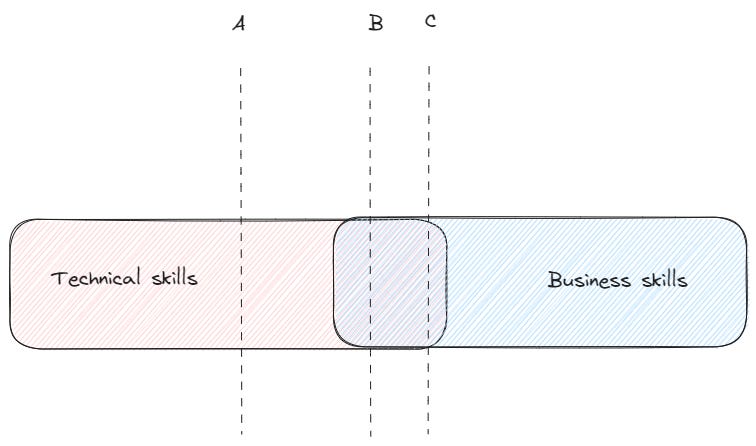
Person A would be the one we talked about - they would be solely focused on writing software. They would typically have a very low tolerance for the ambiguity of non-technical topics. The two other people show that we are all not the same; we all lie in some part of this spectrum. Of the three, person C would probably be least frustrated with dealing with people, their expectations, and managing projects.
This idea of a “tolerance to ambiguity” threshold should serve as a reminder and a possible target for technical people if they venture beyond software and move into more business territory.
P.S. I am teaching this in my course on “Becoming an AI Strategist”, you can check it out here if you want to learn more.